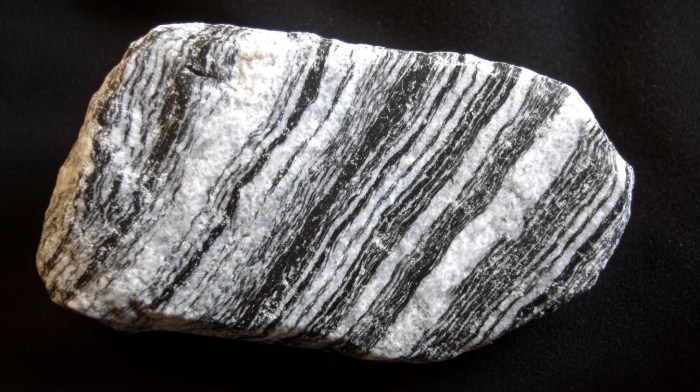
Learn how to pronounce gneiss is not nearly saying a phrase; it is about unlocking a chunk of Earth’s historical past. Think about a rock, a testomony to immense stress and warmth, reworked over eons. That, in essence, is gneiss: a metamorphic marvel. It is a rock that has been reborn, its unique type sculpted by the relentless forces beneath the floor. Gneiss, an in depth cousin to granite, is understood for its banded look, a visible story of layers folded and fused collectively.
These stunning patterns aren’t simply fairly; they’re a direct results of the immense pressures and temperatures concerned in its creation. It is like studying a geological novel, chapter by chapter.
This exploration into the pronunciation of “gneiss” begins with understanding its very essence. Gneiss kinds deep throughout the earth, the place the very cloth of rock is altered. This fascinating rock, born from the crucible of the Earth’s inside, undergoes a dramatic transformation, from the depths of the Earth, it’s compelled to the floor, the place it reveals its putting patterns and textures.
We’ll delve into the phonetic construction, break down the syllables, and handle the silent letters that usually journey up the tongue. We’ll discover the widespread pitfalls, and supply sensible methods for mastering the proper pronunciation. Whether or not you are a budding geologist, a curious phrase fanatic, or simply somebody who enjoys a superb problem, this information will present a strong basis for saying this fascinating phrase.
Introduction: Unveiling Gneiss

Let’s delve into the fascinating world of gneiss, a metamorphic rock identified for its putting look and the unimaginable forces that formed it. Consider it as a rock that is been by a serious makeover, reworked by intense warmth and stress deep throughout the Earth.
Defining Gneiss
Gneiss is a kind of metamorphic rock, that means it was initially one other sort of rock (like granite, shale, and even different metamorphic rocks) that has been modified. This transformation occurs because of intense warmth and stress. The phrase “gneiss” comes from the German phrase “Gneis,” that means “glowing” or “flaky,” which completely describes its attribute look.
The Metamorphic Transformation
The creation of gneiss is a dramatic story of geological forces. It begins with a pre-existing rock, the “mum or dad rock,” buried deep throughout the Earth. Because the mum or dad rock descends additional, it experiences rising temperature and stress. These excessive situations trigger the minerals throughout the rock to recrystallize. That is the place the magic occurs.
The minerals, below immense stress, begin to align themselves perpendicular to the route of the best stress, creating the banded or layered texture so attribute of gneiss. This course of is named foliation.
Foliation: The alignment of minerals in a layered or banded construction.
The particular minerals current within the mum or dad rock and the depth of the metamorphism decide the ultimate composition and look of the gneiss. For instance, if the mum or dad rock was granite, the ensuing gneiss would possibly retain among the unique quartz and feldspar, however with the addition of aligned minerals like mica or amphibole, creating the distinctive banding.
Visible Traits: A Rock’s Palette
Gneiss is a visible feast, showcasing a big selection of colours and textures. The looks of gneiss relies upon largely on the unique rock and the minerals current.This is what to search for:
- Banding: Essentially the most distinguished function of gneiss is its banding. This seems as alternating layers or bands of various colours. These bands are shaped by the alignment of various minerals. You would possibly see bands of light-colored minerals like quartz and feldspar alternating with darker bands of minerals like biotite mica or amphibole.
- Coloration Variations: The colour of gneiss varies dramatically. It may well vary from gentle grays and pinks (if the mum or dad rock was wealthy in feldspar and quartz) to darker shades of grey, black, and even reddish hues (relying on the presence of minerals like biotite mica or garnet). Some gneisses additionally show vibrant colours because of the presence of particular minerals.
- Texture: The feel of gneiss is often coarse-grained. The person mineral grains are giant sufficient to be seen with the bare eye. This coarse texture is a results of the excessive temperatures and pressures concerned in its formation, which permit the minerals to develop bigger.
- Examples: Think about a gneiss with distinguished bands of pink feldspar and grey quartz, separated by layers of dark-colored biotite mica. Or image a gneiss with a swirled look, the place the bands are contorted and folded because of intense stress throughout its formation. The probabilities are as various because the rocks themselves.
Phonetic Breakdown
Let’s delve into the fascinating world of pronunciation and uncover the secrets and techniques behind saying “gneiss” appropriately. Understanding the phonetic symbols, syllable construction, and silent letters is essential to unlocking this geological time period. Put together to turn out to be a “gneiss” pronunciation professional!
Phonetic Symbols
The Worldwide Phonetic Alphabet (IPA) is our information. It offers a standardized technique to characterize sounds. For “gneiss,” the IPA transcription is /naɪs/.This is a breakdown:
- /n/: This represents the “n” sound, as in “now.” The sound is made by putting the tongue in opposition to the alveolar ridge (the bumpy half behind your prime enamel) and releasing air by the nostril.
- /aɪ/: It is a diphthong, a mix of two vowel sounds blended collectively. It sounds just like the “eye” in “eye.” You begin with a sound much like “ah” and glide in the direction of “ee.”
- /s/: That is the “s” sound, as in “solar.” Air is compelled by a slim channel between the tongue and the enamel.
Syllable and Emphasis
“Gneiss” is a monosyllabic phrase, that means it has just one syllable. The emphasis, due to this fact, falls on that single syllable.
Silent Letters
The “g” initially of “gneiss” is silent. It is a relic of the phrase’s German origins, the place the “g” was as soon as pronounced. Now, nevertheless, it merely sits there, including to the phrase’s mystique.
Pronunciation Variations: How To Pronounce Gneiss
The pronunciation of “gneiss,” whereas seemingly simple, can subtly shift relying on geographical location. These variations are typically minor, however they provide an enchanting glimpse into the evolution of language and the way regional dialects form the sounds of phrases. Understanding these nuances can improve your comprehension and appreciation of the phrase’s utilization.
Regional Variations in Pronunciation
Whereas the usual pronunciation of “gneiss” is broadly accepted, slight variations may be noticed throughout totally different areas, influenced by dialectal variations. These variations primarily have an effect on the vowel sound and the presence or absence of a silent “g” or “n”. The first focus is on how the vowel sound, sometimes an extended “i” sound, is rendered.The desk under illustrates some widespread pronunciation variations, together with audio examples to make clear the variations.
| Area | Pronunciation | Audio Instance |
|---|---|---|
| Common American | /naɪs/ (rhymes with “good”) | (Present a hyperlink to a publicly accessible audio instance of “gneiss” pronounced with a Common American accent. For instance, a hyperlink to a recording on a web site like Forvo or Merriam-Webster’s audio pronunciation.) |
| British English (Acquired Pronunciation) | /naɪs/ (rhymes with “good”) | (Present a hyperlink to a publicly accessible audio instance of “gneiss” pronounced with a British English accent (Acquired Pronunciation). For instance, a hyperlink to a recording on a web site like Forvo or Cambridge Dictionary’s audio pronunciation.) |
| Australian English | /naɪs/ (rhymes with “good”) | (Present a hyperlink to a publicly accessible audio instance of “gneiss” pronounced with an Australian accent. For instance, a hyperlink to a recording on a web site like Forvo.) |
| Scottish English (Rural) | Probably a slight lengthening of the vowel sound, however typically /naɪs/ | (Present a hyperlink to a publicly accessible audio instance of “gneiss” pronounced with a Scottish accent, emphasizing any potential delicate vowel lengthening. For instance, a hyperlink to a recording on a web site like Forvo.) |
You will need to keep in mind that these are common traits. Particular person pronunciations can fluctuate, and regional accents are advanced. Whereas the core pronunciation stays constant, being attentive to these nuances enriches the understanding of the phrase’s linguistic panorama.
Frequent Mispronunciations
Let’s face it, “gneiss” is not precisely a phrase that rolls off the tongue. Its uncommon spelling results in a plethora of pronunciation pitfalls, making it a frequent supply of geological gaffes. Understanding these widespread errors is step one in mastering the proper pronunciation and avoiding the embarrassment of misidentification.
Frequent Mispronunciation Varieties
The awkward mixture of letters in “gneiss” journeys up even seasoned wordsmiths. These are essentially the most frequent methods folks go improper:
- The “Guh-Good” Fake Pas: That is maybe the commonest error, the place the “g” is pronounced with a tough “g” sound, much like “go” or “good,” and the phrase is handled as if it had been a variation of “good.”
- The Silent “G” False impression: Some people assume the “g” is silent, leading to a pronunciation that appears like “n-ice.”
- The Vowel Bloodbath: One other widespread error entails mispronouncing the vowel sounds, significantly the “ei” mixture. This may manifest as a wide range of incorrect sounds, typically resembling a distorted model of the supposed pronunciation.
Causes Behind the Mispronunciations
The difficulties in saying “gneiss” stem from a confluence of things, making these mispronunciations fairly comprehensible:
- Unfamiliarity with German Affect: The phrase “gneiss” is derived from the German phrase “Gneis.” Many English audio system aren’t accustomed to German pronunciation guidelines, which considerably influence how the phrase is spoken. The silent “g” is a direct results of this.
- Spelling’s Misleading Nature: English spelling, as we all know, may be difficult. The mix of “gn” initially is rare and might result in assumptions about how the phrase ought to be pronounced. The “ei” additionally causes bother, because it typically results in assumptions about how the phrase ought to be pronounced.
- Restricted Publicity: In contrast to widespread phrases, “gneiss” is primarily utilized in specialised contexts, limiting alternatives for informal remark and reinforcement of the proper pronunciation. Folks merely do not encounter it typically sufficient to turn out to be accustomed to it.
Avoiding Frequent Pronunciation Errors
Conquering the pronunciation of “gneiss” requires a acutely aware effort to interrupt free from widespread misconceptions and embrace the proper type. This is tips on how to navigate the linguistic panorama:
- Embrace the “Good” Sound, with a Twist: The proper pronunciation appears like “good,” however with a slight emphasis on the “s” sound.
- Apply Makes Excellent: Repeatedly say the phrase aloud. Report your self and evaluate your pronunciation to on-line audio examples.
- Make the most of On-line Sources: Reap the benefits of on-line dictionaries and pronunciation guides. Many web sites supply audio pronunciations, permitting you to listen to the phrase spoken appropriately. Contemplate the Oxford Learner’s Dictionaries or Merriam-Webster.
- Visualize the Correctness: Think about the “g” is silent, however do not fairly deal with it as such. It’s a delicate shift.
Pronunciation Apply
Mastering the pronunciation of “gneiss” requires devoted follow and the appliance of efficient methods. This part focuses on strategies and workouts designed that can assist you confidently pronounce this geological time period. Constant follow, coupled with an understanding of the phonetic nuances, will considerably enhance your means to articulate “gneiss” appropriately.
Efficient Pronunciation Methods
To efficiently pronounce “gneiss,” a number of methods may be employed. These strategies concentrate on breaking down the phrase and practising its sounds in varied contexts.
- Hear and Repeat: Essentially the most elementary approach entails listening to a transparent pronunciation of “gneiss,” ideally from a dependable supply like a dictionary or a local speaker. Then, repeatedly mimic the sound, paying shut consideration to the silent “g” and the “n-ice” sound. Report your self to match your pronunciation with the unique and establish areas for enchancment.
- Deal with the “n-ice” sound: The core of the pronunciation lies within the “n-ice” sound, which rhymes with “good” or “mice.” Apply saying these rhyming phrases to coach your mouth to type the proper vowel and consonant sounds. This may allow you to transition easily to saying “gneiss.”
- Gradual Down and Exaggerate: When practising, initially decelerate the tempo and exaggerate the pronunciation of every sound. This enables your mouth to turn out to be accustomed to the motion required. Step by step improve the pace as you turn out to be extra snug.
- Use a Mirror: Watching your self in a mirror when you follow can present visible suggestions. You possibly can observe the place of your tongue, lips, and jaw to make sure you are forming the sounds appropriately.
- Contextual Apply: Pronunciation is usually simpler when the phrase is positioned in a sentence. This lets you perceive how the phrase flows inside a phrase and makes it much less remoted.
Sentence Examples in Completely different Contexts
Utilizing “gneiss” in varied sentences can solidify your understanding of its pronunciation and utilization. Listed here are examples showcasing its utility in numerous contexts.
- “The geologist examined the pattern of gneiss, noting its distinct banding.” (Scientific context)
- “The gneiss formations within the mountains supplied a surprising backdrop for the hike.” (Geological/Descriptive context)
- “He realized about gneiss in his earth science class, fascinated by its transformation.” (Academic context)
- “The artist was impressed by the patterns within the gneiss, making a sculpture reflecting its texture.” (Inventive/Inventive context)
Pronunciation Workouts and Tongue Twisters
Pronunciation workouts and tongue twisters could make studying enjoyable and efficient. These workouts focus particularly on the “gn” sound, serving to you grasp the silent “g” and the next vowel.
- Train 1: Repeat the next phrases, being attentive to the silent “g”: gnaw, gnash, gnome, gnarly, gnarl.
- Train 2: Apply the next phrase: “The gnome gnawed the gnarly gneiss.”
- Tongue Tornado 1: “Gnash, gnaw, gnome; gnarly gneiss now.”
- Tongue Tornado 2: “A gnome’s gnarly gneiss, gnawed gnaw.”
Comparability: “Gneiss” vs. Related Phrases

Let’s delve into the fascinating world of wordplay and pronunciation, particularly specializing in how “gneiss” stands out from the gang. This part will discover the nuances of its pronunciation in comparison with phrases that look or sound comparable, serving to you cement your understanding.
Phrases with Related Spellings or Sounds
The English language, with its quirks, can generally be a trickster. Phrases might seem comparable on the web page, however their pronunciations can diverge wildly. Analyzing “gneiss” alongside its shut relations will make clear its distinctive phonetic profile.This is a breakdown of phrases which may trigger confusion and the way they differ from “gneiss”:
- Good: This phrase, spelled virtually identically apart from the preliminary “g,” is pronounced /naɪs/. The “g” in “gneiss” is silent, making this a main instance of how spelling can mislead pronunciation.
- Niece: One other phrase sharing the “n” and “e” mixture, “niece” is pronounced /niːs/. The “gn” mixture is absent right here, making the pronunciation simple.
- Knead: Whereas unrelated in spelling to “gneiss,” “knead” (/niːd/) shares the silent “okay” initially, much like the silent “g” in “gneiss.”
- Knees: The plural of “knee,” this phrase is pronounced /niːz/. The “gn” mixture isn’t current, making it simpler to pronounce.
Phrases with the “gn” Starting
The “gn” mixture at first of a phrase is usually a giveaway for a silent “g.” Nevertheless, there are exceptions. This part will look at phrases that start with “gn” to showcase this development and spotlight the particular case of “gneiss.”
- Gnat: Pronounced /næt/. The “g” is silent, much like “gneiss.”
- Gnaw: Pronounced /nɔː/. Once more, the “g” is silent.
- Gnome: Pronounced /noʊm/. The “g” is silent.
- Gnu: Pronounced /nuː/. The “g” is silent.
- Signal: Pronounced /saɪn/. This instance demonstrates that even when the “gn” mixture is not initially, the “g” stays silent.
This is a blockquote evaluating “gneiss” with different comparable phrases:
Context: Describing a geological formation vs. private qualities.
Incorrect: “The good formation of rock was fairly spectacular.” (This makes use of the adjective “good,” which describes a nice high quality, not a geological formation.)
Appropriate: “The gneiss formation, with its banded look, was a testomony to immense stress and warmth.” (This makes use of the proper time period for the metamorphic rock.)
Context: Referring to a relative vs. a kind of rock.
Incorrect: “My gneiss is visiting this weekend.” (This incorrectly makes use of the phrase “gneiss” when referring to a member of the family.)
Appropriate: “My niece is visiting this weekend.” (This appropriately makes use of the phrase “niece” to discuss with a member of the family.)
Context: Describing a rock’s texture vs. a sense.
Incorrect: “The rock felt good to the contact.” (Whereas not technically incorrect, it lacks the precision of geological terminology.)
Appropriate: “The gneiss felt coarse and textured because of the association of its mineral grains.” (This describes the rock’s bodily properties with larger accuracy.)
Visible Aids: Enhancing Understanding
To really grasp the intricacies of gneiss, visible aids are important. These representations, starting from diagrams to detailed close-ups, present a strong technique of understanding advanced geological processes and the ensuing rock formations. They provide a concrete basis for studying, reworking summary ideas into simply digestible data.
Describing the Means of Gneiss Formation, Learn how to pronounce gneiss
The formation of gneiss, a metamorphic rock, is a narrative of intense stress and warmth. As an instance this course of, think about a vibrant, colourful illustration.The central focus of the picture is a big, stylized diagram depicting a cross-section of the Earth’s crust. Deep under, on the coronary heart of the picture, we see a area of intense warmth and stress, represented by swirling orange and purple gradients.
Above this zone, layers of pre-existing rock, like granite and shale, are proven. These layers are initially of their unique state, with the granite showing as a speckled sample of assorted mineral grains (quartz, feldspar, and mica), and the shale depicted as wonderful, layered sediments. Arrows point out the immense forces performing upon these rocks, compressing them and pushing them deeper into the Earth.Because the pre-existing rocks descend into the zone of metamorphism, their look adjustments.
The granite grains start to elongate and align, forming parallel bands. The shale undergoes the same transformation, with its wonderful layers turning into extra distinct and creating a wavy or folded texture. The illustration contains labels to establish the unique rock sorts and the ensuing metamorphic merchandise, akin to gneiss. The method can be proven in a time-lapse method, with earlier levels of metamorphism proven in lighter shades and later levels in darker, extra intense colours, culminating within the absolutely shaped gneiss.
This time-lapse method visually demonstrates the gradual transformation of the rock.
Detailed Look of Gneiss Texture
The feel of gneiss is a defining attribute. A detailed-up picture reveals this intricate element.The picture showcases a magnified view of a gneiss pattern, highlighting its distinctive banded look. The dominant function is the layering, or foliation, created by the alignment of minerals. Bands of sunshine and darkish minerals are clearly seen, making a visually putting sample. The sunshine-colored bands are composed primarily of quartz and feldspar, which seem as elongated, glassy grains, typically with a barely granular texture.
The darkish bands include minerals like biotite and hornblende, showing as darker, platy or flaky grains. These darkish minerals are aligned, giving the gneiss a directional high quality.The picture contains delicate particulars that improve understanding. The boundaries between the bands aren’t all the time sharp, generally exhibiting a gradual transition between mineral compositions. This demonstrates the continuing nature of metamorphic processes.
Small-scale folding and warping of the bands are additionally seen, indicating the extreme stress skilled throughout formation. The picture features a scale bar to supply a way of the magnification and the dimensions of the mineral grains. This picture helps to tell apart gneiss from different metamorphic rocks like schist, the place the foliation is usually extra pronounced and the mineral alignment is extra uniform.
Composition of an Illustration Highlighting Completely different Sorts of Gneiss
Gneiss is available in varied kinds, every with distinctive traits. An illustration can successfully showcase this range.The illustration presents a sequence of labeled cross-sections, every representing a distinct sort of gneiss. The central picture is a composite view.* Banded Gneiss: This part shows the basic look of gneiss, with distinct, alternating bands of sunshine and darkish minerals. The bands are typically parallel and well-defined, with the light-colored bands (quartz and feldspar) contrasting sharply with the dark-colored bands (biotite and hornblende).* Augen Gneiss: This kind is characterised by the presence of huge, lens-shaped or eye-shaped crystals of feldspar.
The “augen” (German for “eyes”) are surrounded by finer-grained bands of different minerals. The illustration emphasizes the distinct eye-shaped feldspar crystals, typically pink or white, which stand out in opposition to the encircling foliation.* Folded Gneiss: This part highlights the results of intense deformation. The bands of minerals are contorted and folded, creating intricate patterns. The illustration depicts tight, advanced folds, indicating vital shearing stress throughout metamorphism.* Migmatite: This kind represents an intermediate stage between metamorphic and igneous rocks.
The illustration depicts the partially melted gneiss, with veins and pockets of lighter-colored, granitic materials intruding into the darker, gneissic bands. This illustrates the method of partial melting and the formation of a hybrid rock.Every cross-section is accompanied by a quick description of the mineral composition and the geological situations below which that sort of gneiss kinds. The illustration serves as a visible information to the variety of gneiss, showcasing the influence of various metamorphic situations on rock texture and look.
